
Currency:

USD
HKD
GBP
EUR
CAD
AUD
CHF
INR
USD
sign in · join Free · My account
Home | Sale | Customer Service | Info Tech | Delivery and Payment | Buyer Protection | Policy Information | PC Niche
Your Position: Home > Book > eBooks > The Sunken Chest of Dolly Sherwood

View History

The Sunken Chest of Dolly Sherwood
prev zoom next
The Sunken Chest of Dolly Sherwood
  • Buyer protection: Returns accpeted. Paypal accepeted.
  • Item location: Oxford, United Kingdom
  • Posts to: Worldwide
  • Brand:Nokia
  • Weight:0gram
  • Recently sold:20
  • Market price:$2.99
    Sale price:$1.29
  • User reviews: comment rank 5
  • Total:
  • Quantity:

Goods Brief:

Attribute

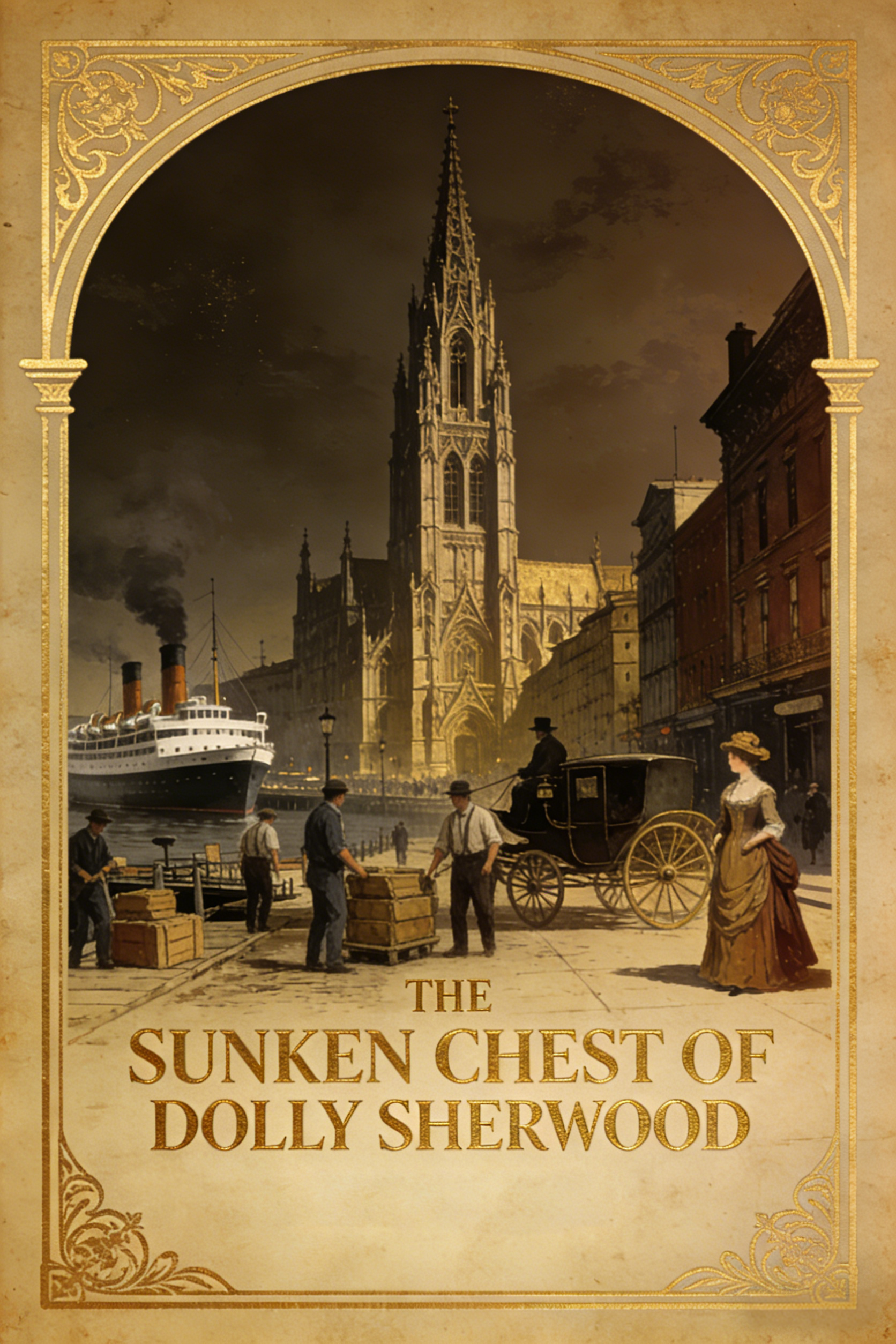
The Sunken Chest of Dolly Sherwood ———  •  ——— A Tale of Gilded Age New York Book One The Pearl of Five Points Chapter I In that dismal autumn of 1873, when the great financial panic had cast its shadow upon the land and the speculators of Wall Street found themselves leaping from windows like so many frightened lemmings, there existed in the notorious Five Points district of New York City a certain establishment known as the Golden Peacock. It was, by all accounts, a house of ill repute - one of those many dens of iniquity that flourished in the shadow of the respectable churches and counting-houses, where the gas lamps burned low and the gin flowed freely, and where men of all stations might purchase, for an evening's diversion, the company of women whose virtue had long since been mortgaged to circumstance. Yet even in such a place, there sometimes emerges a figure of such singular distinction that the very degradation of their surroundings serves only to illuminate, by contrast, the nobility of their character. Such a one was Dolly Sherwood. She was not beautiful in the conventional sense - u2014that painted, powdered prettiness so prized by the patrons of such establishments. Her beauty was of a different order entirely. She possessed eyes of the deepest violet, which seemed to hold within their depths all the sorrow and all the wisdom of her twenty-six years. Her hair, the colour of dark honey, she wore simply, without the elaborate constructions of curl and crimp that were then fashionable. And her figure, though pleasing, was not the voluptuous abundance that such men typically sought, but rather the slender grace of a woodland nymph - delicate, almost ethereal, as though she belonged not to the squalid streets of the Points but to some pastoral scene in the Hudson Valley. What set Dolly apart, however, was not merely her appearance. It was her manner - the quiet dignity with which she moved through those gilded rooms, the gentle firmness with which she declined the more degrading propositions of her clientele, the almost maternal tenderness she showed to the younger girls who, night after night, sold their innocence for a handful of silver. In a trade that reduced women to commodities, Dolly Sherwood remained, somehow, a person - soul of such innate refinement that even the most hardened roues found themselves, in her presence, momentarily elevated from their baser natures. She had come to the Golden Peacock ten years prior, a girl of sixteen, sold by her stepfather - a drunken Irish labourer who had beaten her mother to death and then, discovering that the daughter possessed certain attractions, had determined to monetise them. The madam of the house, a Mrs. Delilah Blackwood, had recognised in the trembling child something rare and valuable - not merely physical beauty, but that ineffable quality that the French call "distinction." Mrs. Blackwood had invested in Dolly's education, teaching her to read and write, to converse on topics of literature and art, to play the pianoforte with a skill that would not have disgraced a concert hall. And in return, Dolly had repaid her patroness many times over, becoming the most celebrated attraction of the Golden Peacock, the woman for whom bankers and politicians, judges and merchants, would pay any price. Yet through all these years of degradation, Dolly had nourished a secret hope. She had saved - oh, how she had saved! While the other girls spent their earnings on ribbons and rouge, on gin and laudanum, Dolly had hoarded every coin, every banknote, every piece of jewellery pressed upon her by admiring patrons. She kept her savings in a small iron chest, hidden beneath the floorboards of her room, and by the autumn of 1873, that chest contained a fortune that would have astonished anyone who knew of its existence. There were diamonds there - diamonds given by a railroad baron who had wept upon her shoulder after the death of his wife. There were rubies from a Southern planter who had lost his plantation in the war and found, in Dolly's arms, a temporary oblivion from his ruin. There were pearls - strings of perfect, milky pearls - from a congressman whose vote had decided the fate of nations. And there was gold - American eagles and double eagles, English sovereigns, French napoleons - a glittering hoard accumulated through ten years of patient sacrifice. Dolly had a plan. She had read, in the books that Mrs. Blackwood had provided, of places where a woman might begin anew - places where the past was not a chain that dragged one down into the mire, but a garment that might be cast off like an outworn dress. The West, they called it - that vast, empty territory beyond the Mississippi where gold was said to lie upon the ground like pebbles, and where a woman with means and determination might forge a new identity, a new life, a new destiny. But Dolly was not so foolish as to attempt such a journey alone. She required a companion - a man of education and refinement who would protect her on the journey, who would stand beside her in the new world, who would lend his name and his respectability to her enterprise. In short, she required a husband - not in the legal sense, for she knew that no clergyman would solemnise such a union, but in the true sense: a partner, a helpmeet, a kindred spirit. And she believed she had found him. Chapter II Arthur Whitmore was, by his own account, a gentleman. He was the younger son of a respectable family from Boston, a graduate of Harvard College, and a student of the law. He had come to New York in the spring of 1873, filled with ambitious dreams of making his fortune in the great metropolis, of establishing himself as a legal practitioner of distinction, of one day perhaps entering politics and following in the footsteps of those great men - Webster, Clay, Calhoun - whose speeches he had committed to memory in his youth. But New York, that great devourer of dreams, had not been kind to young Mr. Whitmore. The financial panic had dried up the stream of clients that might have sustained a fledgling attorney. His savings, carefully accumulated through years of frugal living, had been invested in railroad stocks that were now worth less than the paper they were printed on. And his lodgings, once respectable, had descended through a series of increasingly squalid boarding-houses until he found himself, by October of that fatal year, inhabiting a garret in the Bowery, where the rats competed with the cockroaches for dominion, and where the landlord threatened daily to cast him into the street for non-payment of rent. It was in this state of desperation that Arthur Whitmore had first been drawn to the Golden Peacock. A fellow lodger - a clerk in a dry-goods store who possessed more knowledge of the city's vices than was perhaps desirable - had spoken to him of the establishment and of its celebrated attractions. "There's a woman there," the clerk had said, his eyes gleaming with a mixture of lust and something that might have been awe, "a woman such as you've never seen. They call her the Pearl of Five Points." Arthur had been shocked - proper Bostonian that he was, he had never in his life patronised such an establishment. But desperation makes strange bedfellows, and Arthur was desperate - not merely for the physical release that such a place might offer, but for the companionship, the conversation, the illusion of human connection that his lonely existence so cruelly denied him. He had gone to the Golden Peacock on a rainy Thursday evening in late October. He had dressed himself in his last remaining suit of clothes - the black broadcloth that he had worn to his graduation, now shiny at the elbows and frayed at the cuffs - and had presented himself at the door with all the dignity he could muster. The interior of the establishment had astonished him. He had expected squalor - filth and degradation, the reek of gin and unwashed bodies. Instead, he found a scene of almost opulent elegance. The walls were hung with crimson velvet, the chandeliers blazed with gaslight, and the air was perfumed with the scent of expensive cigars and French perfume. "Your first visit, sir?" The speaker was a tall woman of perhaps forty, with silver-streaked hair and a face that might once have been beautiful. She wore a gown of black silk and carried herself with the authority of a duchess. "It is," Arthur admitted, feeling himself colour beneath her appraising gaze. "Then permit me to welcome you to the Golden Peacock. I am Mrs. Blackwood, the proprietress. May I enquire as to your particular pleasure this evening?" Arthur hesitated. "I - I have heard," he stammered, "of a lady - a Miss Sherwood - " Mrs. Blackwood's eyebrows rose slightly. "Ah. You wish to see Dolly." She studied him for a moment. "May I ask, sir, how you heard of her?" "A - a gentleman of my acquaintance spoke of her. He said - he said she was a woman of remarkable accomplishments." "Indeed she is." Mrs. Blackwood's tone was dry. "Miss Sherwood's company is much sought after." Arthur felt his face burn. He had, in his pocket, exactly seven dollars and thirty cents - his entire worldly wealth. "I should like," he said, with as much dignity as he could summon, "to converse with Miss Sherwood." Mrs. Blackwood nodded. "Very well. Follow me." She led him up a sweeping staircase to a door at the end of a corridor. She knocked softly. "Dolly, my dear. A gentleman to see you." The voice that responded was low and melodious. "Enter, please." Mrs. Blackwood opened the door, and Arthur stepped across the threshold and found himself in a room that seemed, after the opulent vulgarity of the establishment below, to belong to another world entirely. The walls were painted a soft shade of blue, like the sky on a summer morning. The furniture was simple but elegant - a chaise longue upholstered in cream silk, a writing desk of polished mahogany, a bookcase filled with volumes that bore the marks of careful reading. And at the pianoforte, her fingers still resting upon the keys, sat Dolly Sherwood. She was, Arthur realised immediately, even more beautiful than the clerk's description had suggested. But it was not the beauty of a painted courtesan - it was something purer, more refined, almost spiritual. She wore a gown of white muslin, without ornament of any kind. Her hair was arranged simply, drawn back from her face and secured with a single pearl. And her eyes - those remarkable violet eyes - regarded him with an expression that seemed to combine curiosity with something that might have been compassion. "Good evening, sir," she said, rising from the pianoforte. "I am Dolly Sherwood. Please, be seated." Chapter III So began an association that was, by the standards of such things, almost respectable. Arthur visited Dolly three or four times each week, sometimes more often. They would sit in her blue-walled chamber, talking of books and music and the state of the world, while she played the pianoforte and he listened, entranced. To the other inhabitants of the Golden Peacock, this arrangement seemed inexplicable. The other girls mocked Dolly for her eccentricity, for her refusal to accept payment from a man who was obviously penniless. Mrs. Blackwood, though she said nothing, watched the developing relationship with a wary eye, recognising in it the potential for disaster. Dolly did not care. For the first time in ten years, she felt something that might have been happiness. In Arthur Whitmore, she had found a man who valued her not for her body but for her mind, who treated her with the respect due to a lady, who seemed to see in her something that she had almost forgotten existed - the person she might have been, had fate been kinder. And Arthur, for his part, found in Dolly a salvation that he had not dared to hope for. She encouraged his literary ambitions, reading and critiquing the essays he wrote in his garret, urging him to submit them to the magazines. She provided him with small sums of money - always disguised as loans, always accompanied by elaborate fictions about "investments" she had made on his behalf. "I have saved nearly enough," she told him one evening in early December, as they sat before her fire. "Another year, perhaps two, and I shall have sufficient to purchase land in California - a small vineyard, perhaps, or an orchard." Arthur looked at her with admiration mingled with something that might have been envy. "You are remarkable, Dolly. To have accomplished so much, from such beginnings - " "I have had ten years, Arthur. Ten years of saving every penny, of denying myself every pleasure, of treating my body as a commodity to be sold and my soul as a treasure to be preserved." She smiled, but there was sadness in her eyes. "It has not been easy. There have been times - many times - when I have wished simply to end it all. But I have endured. I have endured because I believed that someday, somehow, I would find a way to be free." "And now?" "And now - " Dolly hesitated. "Now I am no longer certain that freedom is possible. Not for me. Not alone." She turned to face him, and her violet eyes were bright with unshed tears. "Arthur, I have a proposal to make to you. I do not know how you will receive it. I fear - I greatly fear - that you will think me presumptuous, or mercenary, or mad. But I must speak, for I do not know if I shall ever have the courage to speak again." Arthur felt his heart begin to race. "Dolly - " "I wish to leave this place," she said, the words tumbling out in a rush. "I wish to go to California, to begin a new life. And I wish - you to come with me." Arthur stared at her, speechless. "I know what you are thinking," Dolly continued. "You are thinking that I am a fallen woman, that association with me would destroy your reputation, that I am trying to trap you into some sordid arrangement. But I swear to you, Arthur, upon everything I hold sacred, that my intentions are honourable. I ask nothing of you but your companionship, your protection, your name. I have money enough for both of us - for the journey, for the purchase of land, for the establishment of a new life." She reached out and took his hands. "I know that you do not love me - not as a man loves a woman. But I believe that you respect me, that you esteem me, that you feel for me something of the friendship that I feel for you. And I believe - oh, I hope - that this might be enough." Arthur was silent for a long moment. He thought of his family in Boston, of their horror if they were to learn of such an arrangement. He thought of his professional prospects, of the doors that would be forever closed to him if he were known to have eloped with a courtesan. And then he looked at Dolly - at her pale, anxious face, at her violet eyes bright with hope and fear - and all these considerations seemed to dissolve like mist in the morning sun. "Dolly," he said softly. "Dear Dolly. Do you truly believe that I do not love you?" She stared at him, her lips parted in surprise. "I have loved you," Arthur continued, "from the moment I first entered this room. I loved you when you played Chopin for me, when you listened to my troubles, when you shared your dreams of California. I have loved you in silence, believing that such love was impossible." He raised her hands to his lips. "If you will have me, Dolly Sherwood, I will go with you to the ends of the earth." Book Two The Shadow of Betrayal Chapter IV The winter of 1873-74 was, in the annals of New York City, one of the most severe in memory. The Hudson River froze solid from shore to shore, and sleighs replaced steamboats as the principal means of transportation. The poor suffered terribly - thousands huddled in freezing tenements, burning furniture and even their own doors to keep warm, while the wealthy retreated to their country estates, where fires blazed in every grate and the wine flowed as freely as ever. In the midst of this frozen desolation, Dolly and Arthur's love continued to flourish. They met as often as circumstances permitted, stealing hours of happiness in Dolly's blue-walled chamber, planning their future with the eager intensity of children planning a forbidden adventure. But the winter was long, and the spring seemed to recede ever further into the future. And as the weeks passed, Arthur began to feel the first stirrings of doubt. It was not that his love for Dolly had diminished - far from it. Each day, he found new reasons to admire her: her patience, her generosity, her unwavering faith in their future. But he could not ignore the reality of their situation. He was a man of education and family, however reduced his circumstances. She was a courtesan - a woman who had sold her body to hundreds of men, whose name was known in every gambling den and brothel in the city. He tried to suppress these thoughts. He told himself that he was being foolish, that love conquered all, that the opinions of society were worthless compared to the happiness they would find together. But the thoughts persisted, gnawing at his confidence like rats at the foundations of a house. And then, in February, he received a letter that brought all his fears to the surface. It was from his father in Boston. The old man wrote that he had learned, through sources he did not specify, of Arthur's association with "a woman of the town." He expressed his shock, his disappointment, his sense of betrayal. He reminded Arthur of the family's honour, of the expectations that had been placed upon him, of the disgrace that would fall upon them all if this association were to become public knowledge. "I beg you, my son," the letter concluded, "to reconsider your course. Break off this connection immediately, before it is too late. Return to Boston, where your mother and I will receive you with forgiveness and love. Do not throw away your future for a moment's passion. Do not destroy yourself for a woman who is, by her very nature, unworthy of your regard." Arthur read the letter with a sinking heart. He burned the letter, but its words remained etched in his memory, rising to torment him in the small hours of the night. He did not tell Dolly of the letter. He could not bear to see the hurt in her eyes, to hear the pain in her voice. Instead, he carried his burden in silence, smiling and making plans even as his confidence eroded like sand before the tide. Chapter V The crisis came in March, when Arthur's tutoring position was abruptly terminated. The merchant's wife, a pious woman who spent her Sundays distributing tracts to the heathen of Five Points, had somehow learned of Arthur's association with the Golden Peacock. She had confronted her husband, threatening scandal and divorce if the "immoral young man" were not immediately dismissed. Arthur was cast into the street without reference, without severance, without even the wages owed him for the previous month. He returned to his garret in despair, knowing that with this dismissal, his last pretence of respectability had been stripped away. He did not go to Dolly that evening. He could not face her, could not bear to confess his failure. Instead, he walked the frozen streets for hours, wandering through the slums of the Bowery and the Points, past the gin mills and the dance halls and the opium dens, until at last he found himself at the waterfront, staring out at the black expanse of the frozen river. He stood there for a long time, watching the ice creak and groan as the tide shifted beneath it. He thought of his father, of his family's disappointment, of the future that had once seemed so bright and now lay in ruins around him. And he thought of Dolly - dear, patient Dolly, who had placed her trust in him, who had entrusted him with her dreams and her savings and her very life. What was he to do? He could not return to Boston, not now, not with this shame upon him. He could not remain in New York, where his name was becoming a byword for dissolution. And he could not - he knew this with sudden, terrible clarity - he could not go to California with Dolly, could not spend his life as the consort of a fallen woman, an object of pity and scorn to all who knew him. He was trapped. Trapped by his love for her, trapped by his promise to her, trapped by the expectations of a society that would never accept their union. Whatever he did, whatever choice he made, he would be destroyed. It was in this state of despair that he encountered Samuel Thorne. Thorne was a man of perhaps fifty, with the weathered face of one who had spent his life in the pursuit of wealth. He had made his first fortune in the California gold fields of '49, his second in railroad speculation, his third in the recent financial panic, buying up distressed properties for pennies on the dollar. "You look like a man with troubles," Thorne observed, approaching Arthur on the waterfront. "Care to share them? I've found that conversation, like whiskey, has a way of easing the burden." Arthur looked at the stranger with bleary eyes. "I doubt you could help me, sir. My troubles are of a - personal nature." "Personal troubles are the most interesting kind." Thorne produced a flask from his coat and offered it to Arthur. "Here. Take a drink. Then tell me your story." The whiskey was cheap and raw, but it burned away some of the chill that had settled in Arthur's bones. Before he knew what he was doing, Arthur found himself pouring out his story - the whole wretched tale of his love for Dolly, his family's disapproval, his loss of employment, his despair at the future. Thorne listened with apparent sympathy. When Arthur had finished, he was silent for a long moment, staring out at the frozen river. "A sad story," he said at last. "A very sad story indeed. But not, I think, without a solution." Arthur looked at him hopefully. "You know of something?" "I know of a way that you might be free." Thorne turned to face him, and his eyes, Arthur noticed for the first time, were cold and calculating. "You say this woman - this Dolly Sherwood - has accumulated a considerable fortune?" "She has saved, yes. Through years of - of sacrifice." "Thirty thousand dollars, you say?" "Approximately." Thorne nodded slowly. "Then the solution is simple. You must sell her." Arthur stared at him, not comprehending. "Sell her?" "Sell her contract. Sell her - arrangement." Thorne smiled, revealing yellowed teeth. "I am a man of business, Mr. Whitmore. I recognise value when I see it. This woman - this Dolly Sherwood - represents a considerable investment. Ten years of training, of refinement, of cultivation. She is, in her way, a work of art. And works of art have their price." Chapter VI Arthur did not visit Dolly the next day. He could not face her, could not look into those trusting eyes and maintain his deception. Instead, he spent the day wandering the city, the thousand dollars heavy in his pocket, his mind churning with guilt and indecision. He told himself that he was considering his options, that he had not yet made up his mind, that there was still time to reject Thorne's offer and remain faithful to his promise. But in his heart, he knew that the decision was already made. He had accepted the money. He had spent the night dreaming of the life it could buy him. The betrayal, in spirit if not yet in fact, was complete. It was Dolly who found him, late in the afternoon. She had grown worried by his absence, alarmed by the rumours she had heard of his dismissal. She had searched for him through the city, asking at his lodgings, at his former place of employment, at every place she could think of where he might be found. She found him at last in a tavern near the waterfront, sitting alone at a corner table, a half-empty bottle of gin before him. "Arthur!" She rushed to his side, her face pale with anxiety. "Thank God I've found you. I've been so worried - " She broke off, staring at him. His face was haggard, his eyes red-rimmed, his hands shaking as they clutched the glass. "Arthur, what is it? What's happened?" He looked up at her, and she saw in his eyes something that made her blood run cold. It was not merely despair, not merely guilt. It was something worse - something that looked almost like relief. "Dolly," he said, his voice thick with drink. "Dear Dolly. Sit down. I have - something to tell you." She sat, her heart pounding in her chest. "What is it? Arthur, you're frightening me." He took a deep breath, as though summoning his courage. "I have secured our passage," he said. "To Albany. To the West. Everything is arranged." Dolly's face lit up with joy. "Oh, Arthur! Is it true? Are we really to go at last?" "We - you are to go tomorrow." He could not meet her eyes. "I have - business to attend to here. I will join you - in a few days. A week at most." Dolly's joy dimmed slightly. "A week? But Arthur, I thought - we were to go together." "And so we shall. But there are - arrangements to be made. Matters to be settled." He reached across the table and took her hands. "Trust me, Dolly. Have I ever deceived you?" She looked at him, searching his face for some clue to his strange behaviour. "No," she said softly. "You have never deceived me." "Then trust me now. Go to Albany. Wait for me there. I will come to you, I swear it, and we shall continue our journey together." He pressed something into her hand - a steamer ticket, she saw, for passage on the morning boat to Albany. "But my things," she said. "The chest - " "I will bring it. I will bring everything. You need only bring yourself." Dolly hesitated. Something in his manner troubled her - a brittleness, a desperation that she had never seen before. But she pushed her doubts aside. Arthur loved her. Arthur would never betray her. "Very well," she said. "I will go. But Arthur - promise me. Promise me that you will come." "I promise," he said, and his voice broke on the word. "I promise, Dolly. I will come." Chapter VII The morning dawned cold and grey, with a thin drizzle falling from a leaden sky. Dolly rose early, dressed herself in her warmest clothes, and made her way to the dock where the steamer to Albany was preparing to depart. She looked for Arthur, but he was nowhere to be seen. Instead, she found Samuel Thorne waiting for her, a smile of welcome upon his weathered face. "Miss Sherwood. A pleasure to see you again." Dolly stared at him, her heart sinking. She remembered Thorne from the Golden Peacock - his persistent attentions, his crude manners, the way his eyes had seemed to strip her bare. "Mr. Thorne," she said coldly. "What are you doing here?" "I might ask the same of you." Thorne's smile widened. "But I believe I know the answer. You are here to meet Mr. Whitmore, are you not? You are here to begin your journey to the West?" "I am," Dolly said. "And I fail to see what business it is of yours." "Oh, it is very much my business." Thorne produced a folded paper from his coat. "You see, Miss Sherwood, I have purchased your passage. I have purchased - your company, for the duration of our journey." Dolly felt the blood drain from her face. "What do you mean?" "I mean that your Mr. Whitmore has sold you to me." Thorne's voice was almost gentle. "For the sum of one thousand dollars, cash, he has transferred to me all his rights and claims upon your person. You are, for all practical purposes, my property." "You lie," Dolly whispered. "Arthur would never - " "Would never what? Would never betray you? Would never abandon you for a handful of silver?" Thorne laughed. "My dear Miss Sherwood, you have been in your profession for ten years. Surely you know by now that men are weak, that their promises are written in water, that they will sacrifice anything - anyone - for their own comfort." He held out the paper. "Here is the receipt, signed by Mr. Whitmore himself. Read it, if you doubt my word." Dolly took the paper with trembling hands. She recognised Arthur's handwriting immediately. And the words, though they seemed to swim before her eyes, were clear enough. "Received from Samuel Thorne, the sum of one thousand dollars, in consideration for which I hereby transfer all my interest in the person and property of Dolly Sherwood, known as the Pearl of Five Points. Signed, Arthur Whitmore." She read it twice, three times, hoping that somehow the words would rearrange themselves. But there was no hidden meaning. There was only the stark, brutal truth. Arthur had sold her. For a thousand dollars. For the price of his own comfort, his own respectability, he had sold her like a horse, like a slave, like a piece of furniture to be disposed of at will. "You have a choice, Miss Sherwood," Thorne was saying. "You may come with me, as my companion, and enjoy the comfort and protection that my wealth can provide. Or you may return to the Golden Peacock, to resume your former life." Dolly looked at him, her violet eyes dry and burning. She felt no anger, no grief, no despair. She felt only a terrible, empty coldness. "Where is he?" she asked, her voice barely audible. "Who?" "Arthur. Where is he?" Thorne shrugged. "I do not know. He took his money and departed. I presume he has returned to Boston, to his family, to the respectable life that your association had denied him." Dolly nodded slowly. "I see." She looked down at the steamer ticket in her hand, then at the receipt she still clutched in the other. She thought of the iron chest, hidden beneath the floorboards of her room at the Golden Peacock. "Very well, Mr. Thorne," she said, her voice steady now, almost serene. "I will accompany you to Albany. But I have conditions." "Name them." "I require a private cabin. I require that you do not attempt to touch me, or to force your attentions upon me in any way. And I require - " She paused. "I require that you send a message to the Golden Peacock, instructing them to deliver my trunk to the dock immediately." Thorne raised an eyebrow. "Your trunk?" "My personal belongings. They are of sentimental value." Thorne studied her for a moment. Then he nodded. "Very well. I accept your conditions." He turned and gestured to a porter, giving instructions for the retrieval of Dolly's belongings. Then he offered her his arm. "Shall we board, Miss Sherwood? The steamer departs in half an hour." Dolly took his arm, her face a mask of perfect composure. She did not look back at the city she was leaving. She looked only forward, toward the river, toward the steamer, toward whatever fate awaited her. She did not know, yet, what she would do. She knew only that she could not return to the Golden Peacock. And she knew that she could not remain with Thorne. But she had a plan. A desperate, dangerous plan. And for that plan to succeed, she needed the iron chest. Book Three The River of Tears Chapter VIII The steamer Hudson Queen was a vessel of moderate size, built for the passenger trade between New York and Albany. She was not a luxurious craft - her cabins were small, her furnishings plain, her cuisine adequate but uninspired. But she was clean, and she was warm, and she made the journey upriver in a reliable thirty-six hours. Dolly occupied a cabin on the upper deck, a small compartment with a narrow bed, a washstand, and a single porthole through which she could watch the passing scenery. Thorne had taken the adjoining cabin, separated from hers by a thin partition of wood. She had not spoken to him since they boarded. She had retired to her cabin immediately, claiming fatigue, and had remained there through the departure from New York, the passage through the crowded waters of the Upper Bay, and the slow journey up the broad expanse of the Hudson. Now, as evening approached, she sat by the porthole, watching the landscape slide past. The river was wide here, nearly three miles from shore to shore, and the far bank was lost in the grey mist of the rainy afternoon. On the near side, the Palisades rose in sheer cliffs of dark basalt. She thought of Arthur. She had thought of little else since Thorne's revelation, turning the matter over and over in her mind, searching for some explanation that would make sense of his betrayal. She did not know. She suspected that she would never know. And in a strange way, she found that she did not care. Whatever his reasons, whatever his excuses, the fact remained: he had sold her. For a thousand dollars, he had sold her to a man he knew she despised. There could be no forgiveness for such an act. She heard a knock at her door. "Miss Sherwood?" It was Thorne's voice. "Dinner is served in the saloon. Will you join me?" Dolly considered refusing. But she was hungry - she had eaten nothing since the previous evening - and she knew that she would need her strength for what was to come. "I will join you in a moment," she called. She rose and examined herself in the small mirror above the washstand. Her face was pale, her eyes shadowed, but she was still beautiful - more beautiful, perhaps, than she had ever been. Suffering had refined her, stripping away the last vestiges of girlish prettiness and revealing the woman beneath: strong, proud, indomitable. She brushed her hair and pinned it simply, touched a little colour to her lips, and wrapped herself in her warmest shawl. Then she opened the door and stepped out to face her captor. Thorne was waiting in the corridor, a smile of satisfaction upon his face. "You look lovely, my dear," he said, offering his arm. "Positively radiant." Dolly ignored the compliment. "You promised me a private cabin," she said. "And that you would not attempt to force your attentions upon me. I trust you intend to honour those promises." "Of course, of course." Thorne's smile did not waver. "I am a man of my word, Miss Sherwood." The saloon was a long, narrow room, occupied by perhaps two dozen passengers. Most were men - merchants, lawyers, politicians - travelling to Albany on business. A few were women, wives or daughters accompanying their menfolk. They looked at Dolly with curiosity and something that might have been suspicion. Thorne led her to a table near the window, summoned the steward, and ordered wine and dinner. "You eat well, my dear," Thorne observed, pouring her a second glass of wine. "I am glad to see it. Many women in your situation would have lost their appetites entirely." "I am not 'many women,'" Dolly said coldly. "And I do not intend to starve myself for your entertainment." "No, indeed." Thorne's eyes gleamed. "You are a remarkable woman, Miss Sherwood. I have always thought so. Even in your - previous establishment - I recognised in you a quality that set you apart from the common herd." "You mean that I refused your advances." Thorne laughed. "Precisely. You refused me, and many others. You held yourself aloof, above the sordid commerce of your trade. It was - it is - most intriguing." "I am not a curiosity, Mr. Thorne. Nor am I a possession, to be bought and sold at your pleasure." "No?" Thorne leaned forward. "But that is precisely what you are, my dear. You are a possession. I have purchased you, for the sum of one thousand dollars. You belong to me." Dolly met his gaze without flinching. "You have purchased nothing, Mr. Thorne. You have bought a deception, an illusion. The man who sold me had no right to do so. I am not his to sell." "Perhaps not. But who is to know? Who is to care?" Thorne spread his hands. "You are here, with me, on this steamer, bound for Albany and points west. Your - Mr. Whitmore - is gone. You have no one, Miss Sherwood. No one but me." He reached across the table and took her hand. "But I can be generous, my dear. I can be kind. I have wealth enough to provide for you in comfort, in luxury, for the rest of your life. You need only - accept my protection." Dolly withdrew her hand. "Your protection? Or your ownership?" "Is there a difference?" Thorne smiled. "In this world, my dear, we are all owned by someone. I offer you a gilded cage, it is true. But it is a cage nonetheless." "And if I refuse?" "Refuse?" Thorne's smile faded slightly. "What choice have you? Where will you go? What will you do? You have no money, no friends, no family. You are alone in the world, Miss Sherwood. Completely, utterly alone." Dolly was silent. She looked out the window at the passing landscape. "I am not alone," she said at last. "I have myself. I have my pride. And I have - " She paused, a faint smile touching her lips. "I have resources that you know nothing of." "Resources?" Thorne's eyes narrowed. "What resources?" "You will see, Mr. Thorne. You will see." Chapter IX The night passed slowly. Dolly did not sleep. She sat by the porthole, watching the moon rise over the river, casting a silver path across the dark water. She thought of her mother, dead these ten years, and wondered what she would have thought of her daughter's fate. She thought of Mrs. Blackwood, who had been kind to her in her way, and of Bridget, her faithful maid, who had wept when they parted. And she thought of Arthur. Arthur, who had seemed so different. Arthur, who had spoken of love and honour and a new life. Arthur, who had sold her for a thousand dollars. She did not weep. She had wept enough in her life, wept until there were no tears left. Now she felt only a cold, hard anger, a determination to see this through to the end. Morning came at last, grey and misty, with a chill wind blowing down from the north. Dolly rose, washed herself in the cold water from the pitcher, and dressed with care. She chose her finest gown, the white silk that she had worn only on special occasions, and pinned her hair with the diamond comb that had been a gift from the railroad baron. She looked at herself in the mirror and was satisfied. She looked like a queen, like a goddess, like a woman who commanded her own destiny. She left her cabin and made her way to the deck. The steamer was making good progress, the paddle wheels churning steadily. The river had narrowed here, and the shores were closer, lined with trees that were beginning to show the first hints of spring. Thorne was waiting for her, wrapped in a heavy overcoat, a cigar clenched between his teeth. "Good morning, my dear. You look - magnificent." "Thank you." Dolly's voice was cool. "I wish to retrieve my trunk from the hold." "Your trunk?" Thorne's eyebrows rose. "What do you need with your trunk? We will be in Albany in a few hours." "I wish to retrieve it now." Dolly's tone brooked no argument. "It contains items of - personal significance. Items that I wish to have with me." Thorne studied her for a moment. Then he shrugged. "Very well." He summoned a steward and gave instructions for the retrieval of Dolly's trunk. The man departed, and they waited in silence. The trunk arrived a quarter-hour later, carried by two sweating deckhands. They deposited it on the deck, near the stern rail, and departed. Dolly stood before the trunk, looking down at it. It was an ordinary enough object - a rectangular box of oak, bound with iron straps, with a heavy padlock securing the hasp. But she knew what it contained. "Well, my dear?" Thorne's voice was impatient. "What is this all about? What is in that trunk that is so important?" Dolly turned to face him. Her violet eyes were bright, almost feverish, and her face was pale as marble. "This trunk, Mr. Thorne, contains my life. Ten years of my life, to be precise. Ten years of sacrifice, of degradation, of hope. It contains everything I have, everything I am, everything I ever hoped to be." She reached into her bodice and produced a small key, which she inserted into the padlock. The lock clicked open. "You bought me for a thousand dollars, Mr. Thorne. You believed that you were purchasing a woman of accomplishment, a companion for your journey, a possession to be used at your pleasure. But you were wrong. You bought nothing. You bought the shadow of a woman, the shell of a life, the ghost of a dream." She lifted the lid of the trunk. The morning light fell upon the contents, and Thorne gasped. Even he, a man of wealth and experience, had never seen such a treasure. The diamonds glittered like stars, the rubies burned like coals, the pearls gleamed with a soft, milky radiance. And beneath the jewels, the gold coins lay in heaps. "My God," Thorne whispered. "My God, woman, what is this?" "This," Dolly said, "is thirty thousand dollars. Thirty thousand dollars, accumulated through ten years of patient saving, of careful investment, of sacrifice beyond your comprehension. This was to be my future, Mr. Thorne. My freedom. My escape from the life that you and men like you forced upon me." She reached into the trunk and lifted out a diamond necklace, letting it cascade through her fingers like water. "This necklace was given to me by a man who loved his wife. He wept when he gave it to me, wept for his betrayal, wept for his weakness. I kept it because it reminded me that even the best of men are flawed." She let the necklace fall back into the trunk and picked up a ruby brooch. "This brooch was given to me by a Southern planter who had lost everything in the war. He gave me this brooch - the last valuable thing he possessed - and asked me to remember him." She set the brooch aside and reached for a string of pearls. "These pearls were given to me by a congressman whose vote decided the fate of nations. He was a powerful man, a feared man. And yet, in my arms, he was as helpless as a child." She let the pearls slip through her fingers. "And this - " She lifted a handful of gold coins. "This is the product of ten years of labour. Ten years of selling my body, my youth, my hope. Every coin represents a night of degradation, a moment of shame, a fragment of my soul that I can never recover." She turned to face Thorne, her eyes blazing. "You believed that you had purchased me, Mr. Thorne. You believed that a thousand dollars was sufficient to buy my person, my compliance, my future. But you were wrong. No amount of money can buy what I possess. No amount of wealth can purchase my pride, my dignity, my self-respect." She stepped to the rail, the handful of gold coins still clutched in her fist. "I will not be bought. I will not be sold. I will not be owned. I am Dolly Sherwood, and I am free." She opened her hand, and the coins fell, glittering, into the river below. Book Four The Depths Chapter X Thorne stared at her, his face a mask of shock and confusion. "What are you doing? Woman, have you lost your mind? That is a fortune you are throwing away!" "It is not a fortune," Dolly said. "It is a chain. A chain that binds me to the past, to the life I have led, to the men who have used me. And I will be bound no longer." She reached into the trunk and lifted out the diamond necklace. For a moment, she held it, watching the light play across its facets. Then, with a swift motion, she cast it over the rail. It seemed to hang in the air for a moment, a constellation of frozen fire, before it plunged into the dark water and was gone. "Stop!" Thorne lunged forward. "Stop, I say! That is worth ten thousand dollars!" "It is worth nothing," Dolly said. "Nothing but my contempt." She picked up the ruby brooch and threw it after the necklace. "You are mad!" Thorne's voice was shrill. "Mad! Those jewels - they are worth a king's ransom!" "They are worth less than the dirt beneath my feet." Dolly reached for the pearls, lifting the entire string in both hands. "These pearls - they were given to me by a man who believed that wealth could purchase love. He was wrong. Love cannot be bought. It cannot be sold. It can only be given, freely and without expectation. And when it is betrayed - " Her voice caught, but only for a moment. "When it is betrayed, it becomes something else. Something darker. Something that demands payment in kind." She cast the pearls into the river. One by one, she lifted the treasures from the trunk and cast them into the water. The diamonds, the rubies, the emeralds, the sapphires - all the glittering hoard that she had accumulated through ten years of patient sacrifice - all of it, she threw away. Thorne watched, paralysed by horror and disbelief. He had never seen such a thing, never imagined that any person, however mad, would destroy such a fortune. And still Dolly continued, her face pale and set, her eyes dry and burning. She did not weep. She did not falter. She moved with the mechanical precision of an automaton, lifting and casting, lifting and casting, until the trunk was empty and the river had swallowed the last gleaming coin. Then she stood, her hands at her sides, looking down at the dark water. "It is done," she said softly. "It is finished." "You are mad," Thorne whispered. "Completely, utterly mad." Dolly turned to face him. Her expression was serene, almost peaceful, like that of a saint who has achieved communion with the divine. "No, Mr. Thorne. I am not mad. I am free. For the first time in ten years, I am truly free. I have nothing now - no money, no possessions, no future. But I have my pride. I have my honour. And I have the satisfaction of knowing that no man will ever own me again." She stepped back from the rail, her white gown billowing in the morning breeze. "Tell Arthur - " She paused, her voice catching for the first time. "Tell Arthur that I forgive him. Tell him that I understand his weakness, his fear, his need for respectability. Tell him that I bear him no ill will, that I wish him happiness in the life he has chosen." "Dolly - " Thorne took a step toward her. But she was already moving, already climbing onto the rail, balancing there for a moment like a figurehead upon a ship's prow. "Tell him," she said, her voice clear and strong, "that I loved him. That I truly loved him. And that love - " She smiled, a smile of such heartbreaking sweetness that Thorne felt his heart contract. "That love was the only real thing in my life. The only thing that mattered. The only thing that could not be bought or sold or thrown away." She spread her arms, like a bird preparing for flight. "Goodbye, Mr. Thorne. May you find in your wealth the happiness that I could not find in mine." And then she leaped. She fell through the air like a white bird, like a falling star, like a prayer offered up to an indifferent heaven. For a moment, she seemed to hang suspended, her gown billowing around her, her hair streaming behind her like a banner. Then she struck the water and was gone, swallowed by the dark river without a sound, without a splash, without a trace. Thorne stood at the rail, staring down at the water, his face white with shock. For a long moment, he could not move, could not speak, could not think. Then, suddenly, he found his voice. "Man overboard!" he screamed. "Man overboard! For God's sake, someone help!" His cries brought the deckhands running, and the passengers, and the captain himself. They crowded around the rail, staring down at the water, shouting instructions, lowering ropes and life preservers. But the river was dark and cold and swift, and Dolly was gone. They searched for an hour, two hours, dragging the water with hooks and nets. But they found nothing - no body, no trace, no sign that she had ever existed. The Hudson had claimed her, as it had claimed so many before her, and it would not give her up. Chapter XI The news reached New York three days later, carried by the steamer's captain in his official report to the authorities. It was printed in the newspapers, briefly and without elaboration: "Suicide on the Hudson. A woman, believed to be a resident of the Five Points district, leaped from the deck of the steamer Hudson Queen on March 15th and was drowned." Arthur Whitmore read the notice in the Boston newspaper, where he had retreated to his father's house, seeking forgiveness and a fresh start. He read it three times, four times, trying to comprehend the meaning of the words. Then he laid the paper aside and went to his room, where he remained for three days, refusing food, refusing water, refusing to speak to anyone. His mother wept. His father raged. The family physician was summoned, and pronounced the young man to be suffering from "nervous prostration." But Arthur could not rest. He knew, with a certainty that no physician's diagnosis could alter, that he had killed her. His betrayal, his cowardice, his thousand pieces of silver - they had driven her to despair, to destruction, to death. On the fourth day, he emerged from his room. He was pale and haggard, his eyes hollow, his hands trembling. But his voice was steady as he addressed his father. "I am leaving, sir. I cannot remain here." "Leaving?" His father's face darkened. "Leaving for where?" "I do not know. Away. Anywhere. I cannot stay in this house, in this city, in this life. I have done something - " He paused, his voice breaking. "I have done something that cannot be forgiven. Something that has destroyed the only person who ever truly loved me." He turned and walked out of the house, out of his father's life, out of the respectable world that had nurtured him and shaped him and ultimately rejected him. He never returned to Boston. He wandered for a time, working at odd jobs, living in flophouses and charity wards, drinking himself into oblivion whenever he could afford the price of a bottle. But absolution did not come. The memory of Dolly haunted him, waking and sleeping. In the end, he found his way to New York, to the waterfront where he had first met Thorne, where he had sold his love for a thousand dollars. He stood there for a long time, staring out at the river. "Forgive me," he whispered. "Oh, Dolly, forgive me." Then he, too, leaped. His body was found three days later, washed up on the shore of Staten Island. The coroner ruled it a suicide, brought on by "intemperance and mental derangement." He was buried in a pauper's grave, and his name was forgotten. Chapter XII Samuel Thorne survived. He completed his journey to Albany, concluded his business, and returned to New York, where he resumed his life of speculation and acquisition. He never spoke of Dolly Sherwood, never acknowledged his part in her destruction. But he was changed, in ways that he himself did not fully understand. He became, in the years that followed, a philanthropist of sorts. He endowed a home for "fallen women," providing shelter and education for those who wished to escape the life of prostitution. He contributed to charitable organisations, to churches, to hospitals. He was praised for his generosity, his public spirit, his commitment to the welfare of the less fortunate. No one knew the truth. No one knew that his philanthropy was driven not by virtue but by guilt, that every dollar he gave was an attempt to buy absolution for the sin he had committed on the deck of the Hudson Queen. He had bought a woman, and she had destroyed herself rather than submit to his ownership. And he would spend the rest of his life trying to forget. He never married. He never formed any close attachment. He died in 1892, a wealthy and respected man, mourned by many, understood by none. In his will, he left a bequest of ten thousand dollars to establish a scholarship for young women of "good character but limited means." The scholarship was named for his mother. He did not name Dolly. He could not bear to speak her name, even in death. Chapter XIII The iron trunk was recovered, some months after Dolly's death, by a fisherman who found it snagged upon a submerged log near the shore. It was empty, of course - its contents had been distributed by the current along the riverbed, buried in the mud and silt, lost forever. The fisherman sold the trunk for a few dollars to a junk dealer, who in turn sold it to a farmer who needed a strongbox for his tools. It passed from hand to hand, gradually falling into disrepair until at last it was cast aside, left to rot in a barn, forgotten by the world. But the story of Dolly Sherwood was not forgotten. It was told and retold in the taverns and gambling dens of Five Points, in the parlours of the wealthy, in the newspapers and magazines that found in her tragedy a source of endless fascination. She became a legend, a symbol, a cautionary tale. She was the woman who had chosen honour over wealth, pride over comfort, death over degradation. She was the Pearl of Five Points, the woman who had thrown away a fortune and then thrown away her life, all for the sake of a love that had betrayed her. Some said she was a saint, a martyr to the cause of female virtue. Others said she was a fool, a madwoman who had destroyed herself for no good reason. Still others said she was a heroine, a symbol of resistance against the oppression of women, the commodification of the body, the tyranny of wealth. No one knew the truth. No one could know, for Dolly had taken her secrets with her to the riverbed, and the river kept its own counsel. But the story endured. It became part of the folklore of New York, one of those tales that seem to embody the spirit of the city itself - the ambition, the greed, the cruelty, and yet also the possibility of redemption, of transcendence, of a dignity that no amount of wealth or poverty could destroy. And somewhere, in the dark depths of the Hudson, the diamonds still glittered. The rubies still burned. The pearls still gleamed with their soft, milky radiance. Waiting. Waiting for someone to find them. Waiting for the day when the river would give up its treasure, and Dolly Sherwood's sacrifice would be remembered once more. Epilogue The Moral of the Story Reader, you have read this tale, and you have judged its characters according to your own lights. You have condemned Arthur for his weakness, Thorne for his greed, the society that made such a tragedy possible for its cruelty and hypocrisy. But I ask you to consider: what would you have done, in their place? Would you have been stronger than Arthur, more faithful than Thorne, more compassionate than the world that condemned Dolly to her fate? Or would you, like them, have succumbed to the pressures of your time, the expectations of your class, the temptations of wealth and respectability? I do not ask these questions to excuse their conduct. Arthur was a coward, Thorne a villain, and the society that made Dolly's life a misery deserves all the condemnation that can be heaped upon it. But I ask them to remind you that we are all products of our age, all prisoners of our circumstances, all capable of both great good and great evil. Dolly Sherwood was a remarkable woman. In a world that sought to reduce her to a commodity, she preserved her dignity. In a society that valued wealth above all else, she chose honour. In a life that offered her nothing but degradation, she found the courage to reject it, even at the cost of her own existence. She was, in her way, a hero. Not the hero of conventional romance, who lives happily ever after with her true love. But a different kind of hero - the hero who refuses to compromise, who will not surrender her principles, who chooses death over dishonour. We may question her choice. We may say that she should have accepted Thorne's protection, that she should have used her wealth to secure her independence, that she should have found some other way to survive. And perhaps we are right. Perhaps her suicide was not an act of heroism but of despair, not of strength but of weakness. But who are we to judge? Who are we, who have never known the degradation she endured, the hope she nurtured, the betrayal she suffered - who are we to say what she should have done, how she should have lived, when and how she should have died? She made her choice. She chose to be free. And in that freedom, however brief, however costly, she found something that no amount of wealth could buy, no amount of poverty could steal, no amount of time could erase. She found herself. And that, reader, is the only treasure that matters. The only treasure worth seeking. The only treasure that endures. The rest - the diamonds, the rubies, the pearls, the gold - is dust. It is the illusion that deceives us, the chains that bind us, the false god that we worship at the cost of our souls. Dolly Sherwood knew this. In the end, she knew it better than anyone. And as she stood upon that rail, her white gown billowing in the morning breeze, her violet eyes fixed upon the dark water below, she was not a fallen woman, not a courtesan, not a commodity to be bought and sold. She was free. And in that freedom, she was more noble, more pure, more truly human than any of the respectable men and women who had used her, betrayed her, and ultimately destroyed her. May we all find such freedom, reader. May we all have the courage to cast away our chains, to reject the false values of our society, to choose honour over wealth and love over comfort. And may we all remember Dolly Sherwood, the Pearl of Five Points, who showed us that even in the darkest depths of degradation, the human spirit can still shine. She sleeps now, in the cold embrace of the Hudson, her diamonds scattered around her like stars, her pearls gleaming in the darkness, her soul at peace. And the river flows on, indifferent, eternal, carrying its secrets to the sea.

Goods Tag

User Comment(This product has 2 customer reviews)

  • No comment
Total 02 records, divided into15 pages. First Prev Next
Username: Anonymous user
E-mail:
Rank:
Content:
Verification code: captcha

KMALL360 Quick Order: Register and make your 1st order together

Fast & Easy! Registration will be done at the same time, and a confirmation will be sent by email.

  • Product:
  • Remark:
    Typically your order will ship within 24 hours.
  • Quantity:
  • Total Price:   (Returns Accepted within 30 Days; Dispatch from the UK)
  • Your name: *
  • Tel:*
  • Country: *
  • Province/State:
  • City:
  • Address: *
  • Your Email: *
  • Set Your Password: *
  • 备注信息:
  • Shipping:
  • Payment: Credit/Debit Cards, and PaypalPapipagoBoleto.DotpayQIWIWebMoneyMOLPayIndonesia BanksDragonpayPaytmCash on Delivery
  •